.jpg)

AI Mental Wellness Companion for Stress Support
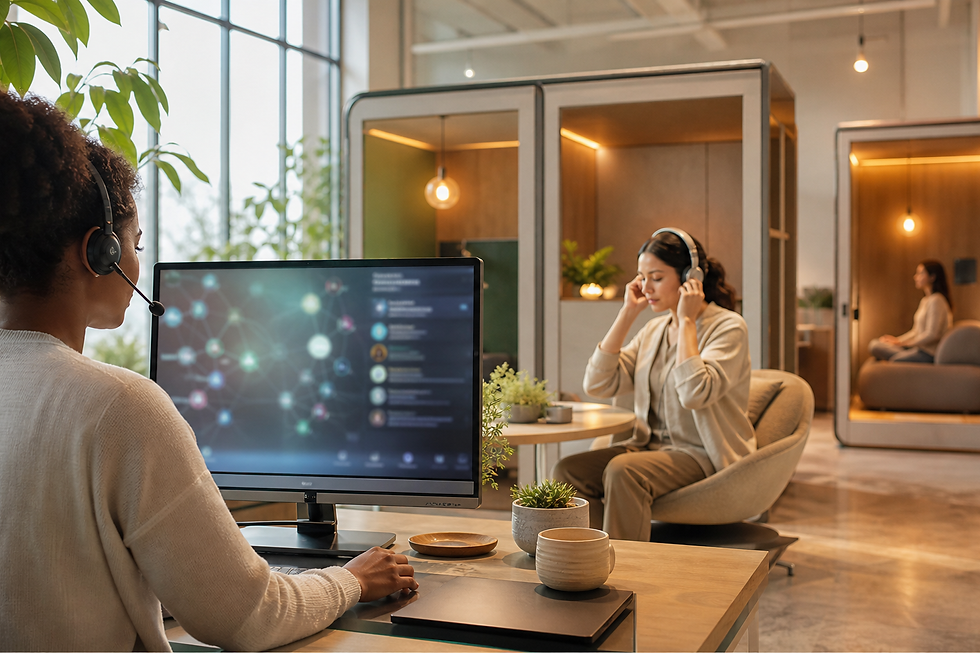
Can an AI mental wellness companion make daily stress support feel more personal, timely and human without pretending to replace professional care?
Mental wellness support is moving from occasional advice into everyday digital touchpoints. For wellness brands, employers, clinics and member communities, the opportunity is not to build a chatbot that says more words. It is to create a calmer support layer that notices patterns, helps people reflect, offers the right next step and knows when a human professional should take over. That is where an AI mental wellness companion becomes more useful than a generic self-care app.
Mimic Wellbeing already explores this blend of digital wellbeing, AI avatars, immersive environments and practical wellness journeys. This article focuses on a more specific gap in that ecosystem: stress check-ins that are frequent enough to be useful, gentle enough to feel safe and structured enough to support real wellbeing programs.
Table of Contents
What Is an AI Mental Wellness Companion?

An AI mental wellness companion is a digital guide that helps people notice emotional patterns, complete short reflections and choose supportive actions. It may appear as a conversational assistant, a voice guide, a digital human, an avatar inside an immersive experience or a quiet prompt inside a broader digital wellbeing platform. The strongest versions are not framed as therapists. They are framed as supportive companions that help users understand what is happening and decide what to do next.
A useful companion can ask a short check-in question, notice whether stress is rising over time, suggest a grounding exercise, recommend a break, route someone to a human coach or encourage professional help when the situation calls for it. The experience should feel consistent and private, not noisy or performative. People are more likely to return when the system remembers preferences, respects boundaries and avoids overclaiming what it can do.
For Mimic Wellbeing, this fits naturally with AI avatars and interactive wellness journeys. A companion can be visual, conversational and emotionally present, but its value comes from good design choices: clear scope, thoughtful prompts, meaningful handoffs and measurable engagement.
Why Stress Check-Ins Need a Better Digital Rhythm

Most stress support happens too late. People often seek help after tension has already built into poor sleep, irritability, avoidance, burnout or physical fatigue. A simple daily or weekly check-in creates a lighter rhythm. It lets users name what they feel before the feeling becomes too large to manage, and it gives organizations a more humane way to encourage prevention rather than reaction.
The design challenge is frequency without fatigue. A companion should not nag people or turn wellbeing into another productivity metric. Short prompts work best: one mood rating, one body signal, one reflection and one next step. The system can adapt the cadence when someone is doing well, checking in less often, and increase support when patterns suggest strain.
This is where Mimic Wellbeing technology can do more than deliver static content. AI can segment users by needs, personalize tone, surface relevant resources and keep the journey cohesive across web, mobile, avatar and XR experiences. The result is a support rhythm that feels like a useful ritual rather than a generic reminder.
How AI Personalizes Support Without Replacing Care

Personalization is the reason an AI companion can outperform a library of wellness articles. One person may need a breathing exercise before a meeting. Another may need a sleep routine, a journaling prompt or a nudge to contact a real professional. The companion can learn which formats a user completes, which prompts are skipped and which interventions lead to calmer follow-up check-ins.
That learning should stay within a responsible support role. The companion can help users reflect, prepare for conversations, identify stressors, practice coping skills and find relevant services. It should avoid diagnosis, treatment claims, crisis counseling and false certainty. Strong products make those boundaries visible in the user experience instead of hiding them in fine print.
Personalization also works best when it is explainable. If the companion suggests a breathing reset, it should be clear whether that suggestion came from a recent check-in, a user preference or a program pathway. Clear reasoning builds trust and helps users decide whether the suggestion actually fits the moment they are in.
A practical AI wellness flow might combine mood tracking, conversational reflection, guided exercises, educational content and human handoff. It can recommend related resources from the Mimic Wellbeing blog, connect users to program pages or invite them to explore a more immersive journey when they want a deeper reset.
Use check-in history to personalize tone and timing.
Recommend small actions before recommending large commitments.
Give users control over reminders, memory and data sharing.
Escalate clearly when the user needs human or clinical support.
Where XR and Digital Humans Add Emotional Presence

Text alone can feel thin when someone is stressed. Voice, spatial audio, a calm visual guide or an immersive breathing environment can make the same support feel easier to follow. XR does not need to be dramatic to be valuable. Sometimes the best use is a short grounding scene, a guided body scan or a quiet virtual space that helps the nervous system slow down.
Mimic Wellbeing’s work with 3D simulations gives this type of companion more range. A user could move from a chat-based check-in to a guided relaxation environment, or a wellness coach could use a digital human to make onboarding feel warmer and more consistent across a large population.
The best digital human experiences feel respectful. They do not imitate intimacy too aggressively, and they do not pressure people to disclose more than they want to share. Instead, they create presence: eye contact, pacing, calm language, gentle feedback and a clear sense that the user remains in control.
Privacy, Safety and Human Escalation Must Come First

Mental wellness data is sensitive. A companion may collect mood, sleep, stressors, habits, voice notes, wearable signals or free-form reflections. That means privacy cannot be treated as a settings page users never read. It has to be part of the product: plain-language consent, selective memory, easy deletion, role-based access and clear separation between personal support and organizational reporting.
Safety design is just as important. If a user signals self-harm, abuse, severe distress or another high-risk situation, the companion should not improvise endlessly. It needs a defined escalation path, crisis resources where appropriate, and human oversight for programs that promise meaningful wellbeing support. This is one of the biggest differences between a responsible AI mental wellness companion and a novelty chatbot.
Teams should also decide what the companion will not do. A clear refusal boundary can be a feature: no diagnosis, no medication guidance, no pressure to continue a conversation during distress and no hidden sharing of sensitive reflections. Those limits make the experience feel more trustworthy because users can understand the role of the product before they rely on it.
For teams building campaigns or member journeys, Mimic Wellbeing advertising experiences can still be engaging while staying careful. The brand experience should help people feel supported and informed, not manipulated into oversharing or convinced that software is a substitute for professional care.
How Brands, Employers and Wellness Teams Can Use It

The strongest use cases are specific. A workplace might use an AI companion for short daily stress resets, manager-safe wellbeing resources and anonymous trend insights. A health club might use it to support habit formation between sessions. A wellness brand might use it for onboarding, product education and guided self-care. A clinic-adjacent program might use it for preparation, reminders and non-clinical support between human appointments.
Each use case needs a clear promise. If the companion is for stress awareness, design for reflection and recovery. If it is for member engagement, design for retention, habit loops and service discovery. If it is for employee wellbeing, design for trust, anonymity and boundaries. Trying to make one companion do everything usually produces a vague experience that users abandon.
A pilot should be measured with both engagement and care-quality signals. Completion rate matters, but so do return visits, opt-outs, successful human handoffs, user comfort and whether people report that the prompts feel respectful. The goal is not more screen time. The goal is a healthier support loop that people are willing to use repeatedly.
A good implementation starts with the journey map: who the user is, what they feel, where they enter, what they need next and which human support channels exist. From there, the experience can connect to Mimic Wellbeing’s broader wellbeing ecosystem through avatars, immersive sessions, educational content and measurable engagement loops.
For employers: micro check-ins, guided resets and safer trend reporting.
For wellness brands: onboarding, education and personalized self-care journeys.
For health communities: supportive reminders and warm handoffs to human teams.
For campaigns: interactive experiences that teach without making clinical claims.
FAQ
What is an AI mental wellness companion?
It is a digital guide that helps users reflect on mood, stress, habits and next steps. It can offer check-ins, exercises, reminders and resource suggestions, but it should not be positioned as a replacement for licensed mental health care.
Can an AI companion diagnose anxiety or depression?
No. A responsible wellbeing companion can help users notice patterns and seek support, but diagnosis and treatment should remain with qualified professionals.
How can AI make stress check-ins more useful?
AI can adapt prompt timing, tone, content and suggested exercises based on user preferences and previous engagement. This makes check-ins feel less generic and more relevant.
Where do AI avatars fit into mental wellness?
AI avatars can make guidance feel more present and approachable. They are useful for onboarding, coaching prompts, breathing exercises and immersive wellbeing moments when designed with clear boundaries.
Is XR useful for stress recovery?
XR can support guided breathing, grounding and relaxation by placing the user in a calm sensory environment. It works best as a short supportive experience, not as a standalone cure.
What privacy controls should a wellbeing companion include?
Strong privacy controls include clear consent, selective memory, easy deletion, secure storage, transparent reporting and limits on what employers or program owners can see.
How should a companion handle crisis signals?
It should follow a defined escalation pathway, provide appropriate crisis resources where relevant and route users toward human or clinical support instead of continuing as if the situation is ordinary.
Who can use an AI mental wellness companion?
Employers, wellness brands, health communities, member programs and digital wellbeing platforms can use one when the scope is clear, privacy is strong and human support pathways are available.
Conclusion
An AI mental wellness companion is most valuable when it is humble, consistent and well designed. It can make stress support easier to access, help people build healthier reflection habits and create a more personal bridge between digital content and human care. The opportunity is not to replace the people who provide real support. It is to make the moments between human support more useful, safer and easier to navigate.


Comments